
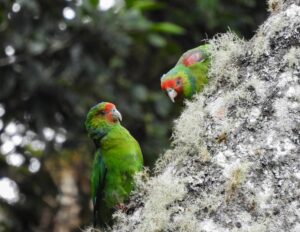
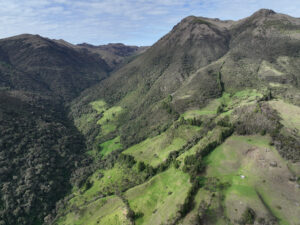
Conserva Aves, American Bird Conservancy (ABC), Fundación de Conservación Jocotoco and Rainforest Trust announced the creation of the Ridgely Reserve in Selva Alegre, Loja province, Ecuador. This new protected area covers 210 hectares in the Chilla mountain range and is home to the largest known population of the red-fronted parrot (Hapalopsittaca pyrrhops), an endangered species with a world population of no more than 2,400 individuals.

Photo: Paúl Molina
Red-headed Parrot (Hapalopsittaca pyrrhops) in the Ridgely Reserve
Located in southern Ecuador, this new reserve seeks to conserve one of the continent’s most endangered species and restore the environmental health of its mountain ecosystems.
Conserva Aves, American Bird Conservancy (ABC), Fundación de Conservación Jocotoco and Rainforest Trust announced the creation of the Ridgely Reserve in Selva Alegre, Loja province, Ecuador. This new protected area covers 210 hectares in the Chilla mountain range and is home to the largest known population of the red-fronted parrot (Hapalopsittaca pyrrhops), an endangered species with a world population of no more than 2,400 individuals.
In addition to conserving this Neotropical bird, the reserve will have a positive impact on local communities by protecting clean water sources, reducing the risk of landslides, and maintaining the functionality of the region’s ecosystems. This milestone represents a decisive step towards protecting the biodiversity of the cloud forests of southern Ecuador and northern Peru.
Sanctuary for an endangered species
The red-faced parrot, barely 22 cm long, is easily recognizable by the bright red around its beak and the bluish and greenish tones that cover it. Although it usually moves in pairs or small groups, its presence is scarce: it inhabits only the montane cloud forests of this part of the continent.
During the last decades, deforestation for agriculture and livestock activities has led to a rapid loss of its habitat. As a result, the IUCN reclassified this species from “Least Concern” to “Endangered” on the Red List of Threatened Species in 2023. The creation of the Ridgely Reserve seeks to reverse this trend by improving habitat connectivity and reducing pressures on the ecosystem.

“The red-faced parrot is a very rare species and sensitive to habitat fragmentation,” explains Marcelo F. Tognelli, ABC’s international projects officer. “The creation of this reserve will not only help ensure its survival, but will also bring environmental benefits to local communities.”
A legacy for conservation
Ridgely’ encompasses diverse ecosystems, from high altitude stunted forests to páramo areas, including agricultural areas, plantations and Andean forests. More than 90 bird species have already been recorded in this still little explored region, which reinforces its importance for conservation.
However, deforestation has advanced at an alarming rate. In the last 28 years alone, 46% of Selva Alegre has been transformed by human activities. This loss of habitat affects not only the red-faced parrot, but also a great diversity of species that depend on this unique ecosystem.

For this reason, the Jocotoco Foundation promoted the declaration of the reserve, which is named after one of its co-founders, Dr. Robert Ridgely, a world-renowned ornithologist who has spent more than four decades exploring, documenting and protecting the continent’s avifauna.
“Bob Ridgely and the other founders of Jocotoco have left an extraordinary legacy by creating our reserves and expanding protected areas in Ecuador,” said Martin Schaefer, executive director of Fundación Jocotoco. “This new reserve at Selva Alegre is a clear demonstration of that legacy in action.”
Canned Poultry Ecuador
In Ecuador, Conserva Aves is working to designate or expand more than 190,000 hectares of protected areas through public calls for proposals and direct investment mechanisms. The creation of nature reserves has also been a priority for ABC, which has already contributed to conserving more than 450,000 hectares in 15 countries together with local partners.
The Ridgely Reserve will not only help conserve a unique species, but will also open up opportunities for nature-based tourism, scientific research and the strengthening of local communities. It is an example of how conservation can generate real benefits for biodiversity and people, working collaboratively and based on science.
