
In the Potosí valleys, in the Cuñurani community adjacent to the Torotoro National Park, a strategic partnership between Quechua communities and the Conserva Aves hemispheric initiative is promoting the creation of a 10,000-hectare community-managed protected area. The initiative aims to protect one of Bolivia’s most iconic and endangered endemic birds, the red-fronted macaw (Ara rubrogenys).

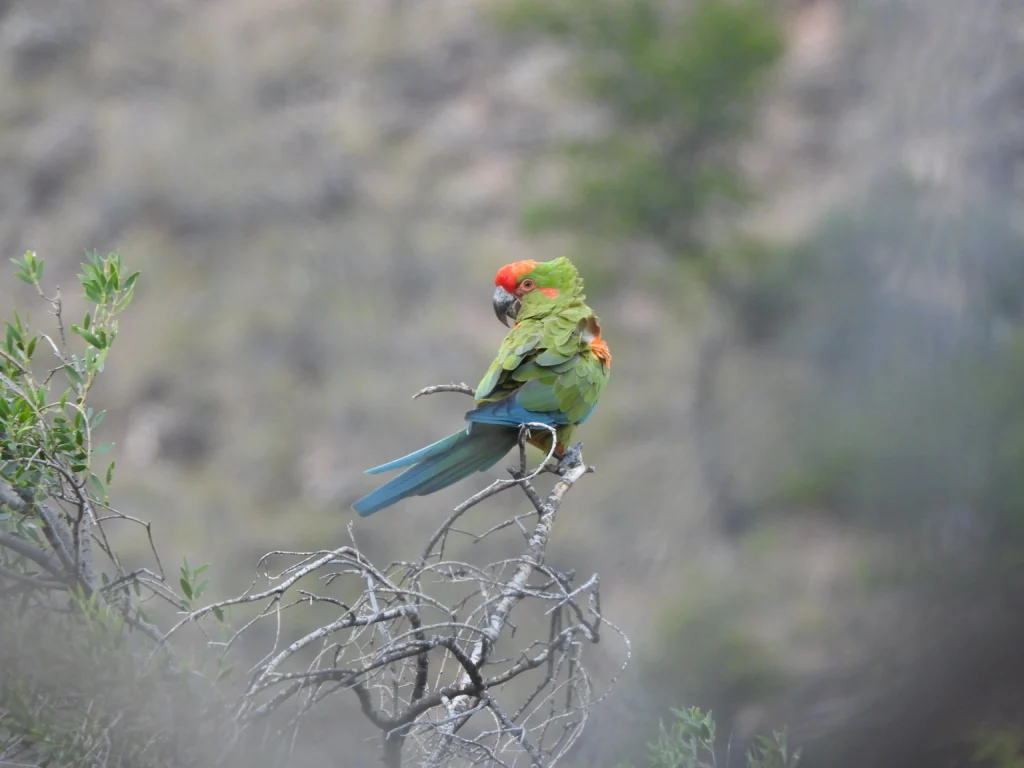
A red-fronted macaw is perched on top of a tree. Photo credit: Tomás Calahuma.
A red-fronted macaw is perched on top of a tree. Photo credit: Tomás Calahuma.
At 5:30 a.m., the Caine River Canyon is a monumental silhouette of shadows and twilight. It is a deep canyon that cuts through the dry inter-Andean valleys of Potosí. The air is thick and cold, but the silence is short-lived. From the deep crevices and ledges of the rocky walls, a shrill, metallic echo pierces the dawn. These are the first squawks of the red-fronted macaw (often called paraba) —a display of communal synchronization that begins the daily routine of one of Bolivia’s most iconic and endangered birds.
Before taking flight, these birds gather at the upper edges of the canyon. They stretch their bright green wings, accented by the vibrant red of their foreheads and shoulders, and bask in the sun’s first rays in what appears to be a meticulously coordinated assembly.

The red-fronted macaw, which is endemic to the dry inter-Andean valleys, is an umbrella species. By protecting it, we also protect the dry forests and the biodiversity they harbor.
In a critical scenario marked by the threat of climate change, conserving this species is an urgent priority.
Unlike other large parrots, the red-fronted macaw does not form permanent flocks of hundreds of individuals. Instead, it organizes into family groups, pairs, and small groups of five to 30 individuals that gather in specific nesting and feeding areas.
Their native diet is a testament to their adaptation. They forage for seeds and fruits from dry forest trees, such as soto (Schinopsis haenkeana) and jarca (Acacia visco), as well as cacti, like cardón, and various carob trees (Prosopis spp.). They have an astonishing trait: unlike other parakeets, they frequently descend to the ground and walk deftly to gather fallen seeds.
Parakeet flocks never let their guard down. While most are feeding, one or two sentinels perch on the highest branches and watch the sky for hawks or eagles. At the slightest alarm call, the group takes flight in an instant.
Very early in the morning, before daylight has fully broken, parabas tend to gather near crops or in cornfields. They perch on stubble or on the ground, walking with great dexterity and silence to feed on dry grain.

Something similar happens in peanut fields: the parabas descend to the ground and, as they move skillfully forward, they dig to find the oily seed, which is their favorite food.
At midday, with a dry, stifling heat, the air in the canyon becomes dense and heavy, and activity ceases abruptly. Between 10:30 a.m. and 3:30 p.m., the parabas enter a siesta, a state of absolute rest hidden in the dense vegetation of secondary ravines to avoid dehydration. This is a time for intimacy: the pairs—which practice strict lifelong monogamy—groom each other, reinforcing a bond so close that even in mid-flight their wings almost brush against one another. Meanwhile, the juveniles play in the branches, practicing nipping and swinging.
The life of the red-fronted macaw in the canyon is dictated by sudden temperature changes—extreme cold in the mornings and evenings, and dry, suffocating heat during the day—and an unshakable social structure.
Today, this birdwatching paradise stands at a crossroads. The area faces severe threats stemming from climate change, such as rising temperatures and reduced and irregular rainfall. Additionally, there is a latent conflict with local agriculture: during the corn and peanut harvest seasons, the parabas stray from their native routes and visit farm fields, causing economic losses and tensions with local farmers.
New territory of life
For the reasons described above, the project in Cuñurani holds historical significance: the Caine River basin is home to 15.6% of the global population of red-fronted parabas, including Torotoro National Park and areas further north.
The project to create this protected area is supported by the continuous monthly monitoring that the Center for Studies in Theoretical and Applied Biology (BIOTA) has been conducting since October 2024, focused on recording and protecting their nesting sites to understand their lifestyle.
Recognizing that conserving nature requires comprehensive solutions to habitat challenges, BIOTA’s actions go beyond scientific research. To reduce conflicts between farmers and the red-fronted parakeet, plots of corn, peanuts, and native vegetation have been set aside to ensure the birds’ food supply.
Through the implementation of these plots, BIOTA and local stakeholders are fostering conditions for the continued presence of this iconic bird in its natural habitat and a more sustainable coexistence between communities and wildlife.
Furthermore, the initiative has worked on a Restoration Plan for the Inter-Andean Dry Forest, which involved installing more than two linear kilometers of protective fencing, implementing modern irrigation systems, and establishing a community nursery with 3,000 seedlings of native species to reforest this important ecosystem.
The plant species selected for the community nursery, due to their importance in the red-fronted parakeet’s diet, include: the soto (Schinopsis haenkeana), the tipa (Tipuana tipu), the ch’añara (Sarcomphalus mistol), the jacaranda (Jacaranda mimosifolia), the kullki (Prosopis kuntzei), and the itapallu (Cnidoscolus tubulosus), among others.
In close collaboration with the communities and the international initiative Conserva Aves, BIOTA is promoting the creation of a Community Protected Area in Cuñurani. The ambitious yet urgent goal is to establish a 10,000-hectare subnational sanctuary.
Additionally, BIOTA is working to strengthen community-based tourism, birdwatching, guiding, trail improvement, maintenance of natural lookouts, and signage.
In coordination with the Qhewayllani School, BIOTA is developing environmental education activities focused on birdwatching. Through these activities, children will learn to identify birds and understand their importance to the balance of nature.
Unforgettable images accompanied by a magical moment
After a long and demanding hike under the valley’s relentless sun, the effort was rewarded in a once-in-a-lifetime moment: the presence of a majestic creature, perched atop a grove, commanding the landscape with regal calm. Minutes later, its takeoff—wide, elegant, imposing—was captured in flight, like a scene that encapsulates the very essence of wildlife.
This brief yet powerful encounter with biodiversity is also a reminder of what is at stake: the fragility and irreplaceable value of this species in its natural habitat. However, the moment held one final revelation. As the bird flew past the camera lens, it dropped a small feather—a chance gesture that became a symbol. It was more than an object; it was a sign, an intimate and silent reward. This moment encapsulates the symbolic and ecological value of protecting this species and its territory.
Subnational protected areas are not just lines on a map. They are true territories of life, as the Conserva Aves motto rightly states. The survival of the red-fronted parakeet in Caine Canyon today depends on the continuity of partnerships between science, international funding, and Quechua community wisdom. By protecting its flight, we ensure that future generations will also wake up to the wild and free echoes of the inter-Andean dry forest.
Quechua Identity and Conservation
The success of conservation efforts in Cuñurani stems from their focus on inclusion and community empowerment rather than isolation. The project encompasses four Quechua communities. The community members act as both guardians and guides along the Paraba Trail, leading researchers and visitors up the steep paths of the canyon. They also integrate biodiversity into their economic and cultural fabric.
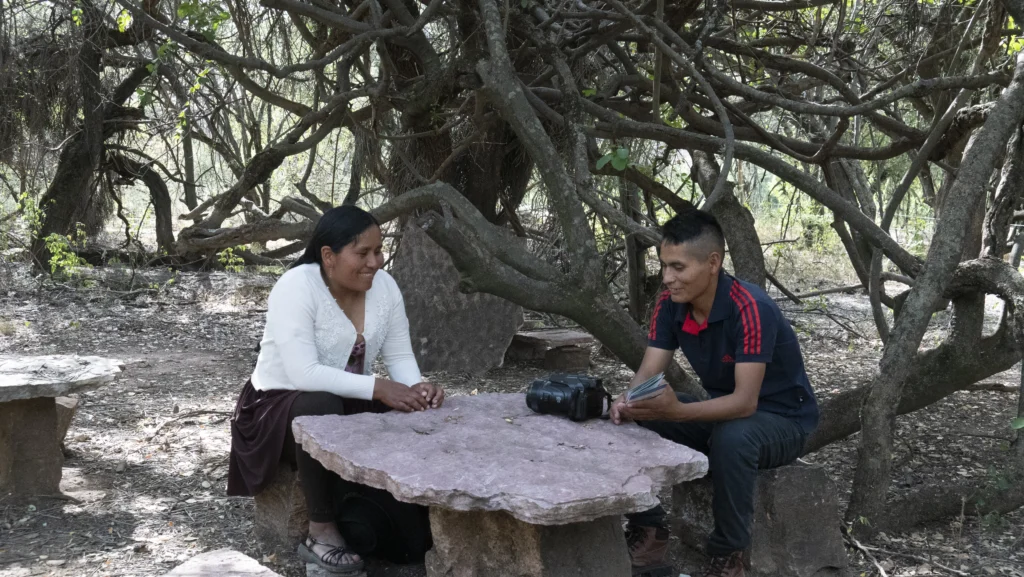
The communities display and sell textiles and handicrafts inspired by their surroundings to buyers from around the world through their artisan center located in the municipality of Torotoro, the nearest tourist hub. The initiative of the protected area aims precisely at that: to promote regulated ecotourism, encourage the reforestation of native species, and ensure that conservation benefits the local economy.
This project in Bolivia is funded by the Bezos Earth Fund.
Conserva Aves: A Hemispheric Strategy with Local Roots
The effort in Cuñurani is not an isolated event but part of a bold vision that seeks to connect conservation efforts from Mexico to Chile. Conserva Aves is an initiative led by a hemispheric coalition with a global reach: The American Bird Conservancy, Audubon, BirdLife International, Birds Canada, and the Network of Environmental Funds in Latin America and the Caribbean (RedLAC). Inspired by the successful Conserva Colombia program, which created 95 protected areas between 2009 and 2017, Conserva Aves was launched through a strategic partnership and seed funding provided by the Bezos Earth Fund.
Conserva Aves creates, consolidates, and strengthens over 100 subnational protected areas, including municipal, communal, ethnic, and private areas, with the goal of covering over two million hectares across nine Latin American countries. Birds are at the heart of this initiative because they are perfect bioindicators of the planet. They are easy to hear and observe and are highly sensitive to environmental changes; therefore, their health directly reflects the health of the entire ecosystem. By protecting the red-fronted macaw, we safeguard water, dry forests, and the biodiversity that sustains human communities. Furthermore, this initiative is a vital part of the 30×30 Agenda, an international commitment to protect 30% of the planet’s key territories by 2030.
